Journal Volume

Vol. 2 No. 2 (2019)

Explore the published articles and volume details.

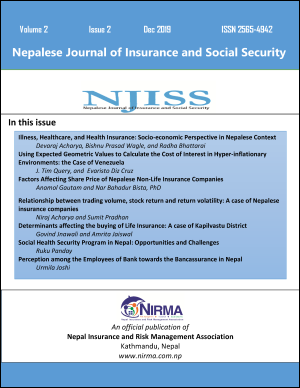
Vol. 2 No. 2 (2019) cover

Vol. 2 No. 2 (2019)

Research Article calendar_today Dec 31, 2019

Illness, Healthcare, and Health Insurance: Socio-economic Perspective in Nepalese Context

group

Authors

Devaraj Acharya, Bishnu Prasad Wagle, Radha Bhattarai

sell

Keywords

Disease and illness Health Inequality Health Insurance Seller of Illness and Healthcare

Abstract

The Government of Nepal has introduced a health insurance programme since 2016. The main essence of the program is to reduce the gap in the utilization of health services between poor and rich, to reduce the out-of pocket expenditure while receiving the healthcare services, and to protect the family from poverty due to catastrophic healthcare expenditure. Researchers review the policy, programme and existing practice Data from Health Insurance Board shows that the programme appears not so effective in many districts but it looks successful in some districts where private healthcare providers are existing as a referral hospital. It is still unanswered whether the HIP is going to boost industrialists in the name of basic rights, health equity and social justice. The paper studies socio-economic and political perspectives of healthcare and health insurance with reference to Nepal and concludes that the healthcare system needs to reform for real welfare, social justice, and citizens' access and right to healthcare.

See more

The Government of Nepal has introduced a health insurance programme since 2016. The main essence of the program is to reduce the gap in the utilization of health services between poor and rich, to reduce the out-of pocket expenditure while receiving the healthcare services, and to protect the family from poverty due to catastrophic healthcare expenditure. Researchers review the policy, programme and existing practice Data from Health Insurance Board shows that the programme appears not so effective in many districts but it looks successful in some districts where private healthcare providers are existing as a referral hospital. It is still unanswered whether the HIP is going to boost industrialists in the name of basic rights, health equity and social justice. The paper studies socio-economic and political perspectives of healthcare and health insurance with reference to Nepal and concludes that the healthcare system needs to reform for real welfare, social justice, and citizens' access and right to healthcare.

Research Article calendar_today Dec 31, 2019

Using Expected Geometric Values to Calculate the Cost of Interest in Hyper-inflationary Environments: the Case of Venezuela

group

Authors

J. Tim Query, Evaristo Diz Cruz

sell

Keywords

Acuatuarial liabilities Social security Projected benefit Macaulay duration

Abstract

It is of vital importance to explore the relationship between pensions and inflationary levels because this forms a link between social policy and economic development in the context of Venezuela’s challenging economy and its impact on the development of pension systems. With such rampant inflation, companies must adjust the rates of salary increases to avoid a significant decrease in the purchasing power of income from defined benefit plans. Our research seeks to find the possibility of using an average geometric rate of future interest rates expressed as an expected value to discount obligations. Consequently, the cost of interest associated with the actuarial liability of the Benefit plans increases substantially in the next fiscal period to the actuarial valuation, sometimes compromising its sustainability over time. In order to minimize this problem, two scenarios for calculating the interest rate are proposed to smooth out this volatile effect; both are based on a geometric average with the expectation of working life or with the duration of the obligations. We are careful to use a reasonable interest rate that is not so high as to compromise the cash flow, resulting in skewed annual results of the companies. Our research seeks to find the possibility of using an average geometric rate of future interest rates expressed as an expected value to discount obligations. We formulate and actuarially evaluate two different scenarios, based on job expectations and Macaulay's duration, of the obligations that allow the sustainability of the plan in an environment of extremely high inflation. To illustrate the impact of the basic annual expenditure of the period, the results of an actuarial valuation of an actual Venezuelan company were utilized. Despite some companies adjusting their book reserves increasingly through a geometric progression, the amounts associated with the costs of interest would be huge in any such adjustment pattern. Therefore, we suggest adoption of one of the alternatives described in the research.

See more

It is of vital importance to explore the relationship between pensions and inflationary levels because this forms a link between social policy and economic development in the context of Venezuela’s challenging economy and its impact on the development of pension systems. With such rampant inflation, companies must adjust the rates of salary increases to avoid a significant decrease in the purchasing power of income from defined benefit plans. Our research seeks to find the possibility of using an average geometric rate of future interest rates expressed as an expected value to discount obligations. Consequently, the cost of interest associated with the actuarial liability of the Benefit plans increases substantially in the next fiscal period to the actuarial valuation, sometimes compromising its sustainability over time. In order to minimize this problem, two scenarios for calculating the interest rate are proposed to smooth out this volatile effect; both are based on a geometric average with the expectation of working life or with the duration of the obligations. We are careful to use a reasonable interest rate that is not so high as to compromise the cash flow, resulting in skewed annual results of the companies. Our research seeks to find the possibility of using an average geometric rate of future interest rates expressed as an expected value to discount obligations. We formulate and actuarially evaluate two different scenarios, based on job expectations and Macaulay's duration, of the obligations that allow the sustainability of the plan in an environment of extremely high inflation. To illustrate the impact of the basic annual expenditure of the period, the results of an actuarial valuation of an actual Venezuelan company were utilized. Despite some companies adjusting their book reserves increasingly through a geometric progression, the amounts associated with the costs of interest would be huge in any such adjustment pattern. Therefore, we suggest adoption of one of the alternatives described in the research.

Research Article calendar_today Dec 31, 2019

Factors Affecting Share Price of Nepalese Non-Life Insurance Companies

group

Authors

Anamol Gautam, Nar Bahadur Bista

sell

Keywords

Dividend per share firm's size market price price earnings ratio

Abstract

This study examines the factors affecting the share price of Nepalese non-life insurance companies. This study is based on secondary data of 15 non-life insurance companies with 105 observations for the period from the fiscal year 2011/12 to 2017/18. The result shows that firm size is positively related to market price of share and price earnings ratio. It indicates that larger firm size leads to increase in market price of share and price earnings ratio. However, the study shows that inflation is negatively related to market price of share and price earnings ratio. The study also shows that dividend per share and return on assets are negatively related to the market price of share and price earnings ratio. Similarly, earnings per share have negative relationship with market price of share and price earnings ratio. The study concludes that the increase in return on assets and earnings per shares do not explain the variation in stock price in Nepalese non-life insurance companies. Nepal is one of the emerging economy; the determinants identified will provide knowledge to the potential investors about the key factors affecting share prices in the country and accordingly assist them in optimizing their investment strategy. The knowledge of the factors and their possible impact on share prices is highly appreciable as it would help investors make wise investment decisions and enable firms to enhance their market value.

See more

This study examines the factors affecting the share price of Nepalese non-life insurance companies. This study is based on secondary data of 15 non-life insurance companies with 105 observations for the period from the fiscal year 2011/12 to 2017/18. The result shows that firm size is positively related to market price of share and price earnings ratio. It indicates that larger firm size leads to increase in market price of share and price earnings ratio. However, the study shows that inflation is negatively related to market price of share and price earnings ratio. The study also shows that dividend per share and return on assets are negatively related to the market price of share and price earnings ratio. Similarly, earnings per share have negative relationship with market price of share and price earnings ratio. The study concludes that the increase in return on assets and earnings per shares do not explain the variation in stock price in Nepalese non-life insurance companies. Nepal is one of the emerging economy; the determinants identified will provide knowledge to the potential investors about the key factors affecting share prices in the country and accordingly assist them in optimizing their investment strategy. The knowledge of the factors and their possible impact on share prices is highly appreciable as it would help investors make wise investment decisions and enable firms to enhance their market value.

Research Article calendar_today Dec 31, 2019

Relationship between trading volume, stock return and return volatility: A case of Nepalese insurance companies

group

Authors

Niraj Acharya, Sumit Pradhan

sell

Keywords

Dividend per share firm size market price of share price earnings

Abstract

This study examines the factors affecting the share price of Nepalese non-life insurance companies. The knowledge of the factors and their possible impact on share prices is highly appreciable as it would help investors make wise investment decisions and enable firms to enhance their market value. This study is based on secondary data of 15 non-life insurance companies which are listed in Nepal stock exchange. The study covers seven years period from the fiscal year 2011/12 to 2017/18. The result shows that firm size is positively related to market price of share and price earnings ratio. It indicates that larger firm size leads to increase in market price of share and price earnings ratio. However, the study shows that inflation is negatively related to market price of share and price earnings ratio. The study also shows that dividend per share and return on assets are negatively related to the market price of share and price earnings ratio. Similarly, earnings per share have negative relationship with market price of share and price earnings ratio. The study concludes that the increase in return on assets and earnings per shares do not explain the variation in stock price in Nepalese non-life insurance companies. Nepal is one of the emerging economy; the determinants identified may provide knowledge to the potential investors about the key factors affecting share prices in the country and accordingly assist them in optimizing their investment strategy.

See more

This study examines the factors affecting the share price of Nepalese non-life insurance companies. The knowledge of the factors and their possible impact on share prices is highly appreciable as it would help investors make wise investment decisions and enable firms to enhance their market value. This study is based on secondary data of 15 non-life insurance companies which are listed in Nepal stock exchange. The study covers seven years period from the fiscal year 2011/12 to 2017/18. The result shows that firm size is positively related to market price of share and price earnings ratio. It indicates that larger firm size leads to increase in market price of share and price earnings ratio. However, the study shows that inflation is negatively related to market price of share and price earnings ratio. The study also shows that dividend per share and return on assets are negatively related to the market price of share and price earnings ratio. Similarly, earnings per share have negative relationship with market price of share and price earnings ratio. The study concludes that the increase in return on assets and earnings per shares do not explain the variation in stock price in Nepalese non-life insurance companies. Nepal is one of the emerging economy; the determinants identified may provide knowledge to the potential investors about the key factors affecting share prices in the country and accordingly assist them in optimizing their investment strategy.

Research Article calendar_today Dec 31, 2019

Determinants affecting the buying of Life Insurance: A case of Kapilvastu District

group

Authors

Govind Jnawali, Amrita Jaiswal Jaiswal

sell

Keywords

Life insurance demand Kapilvastu district Socio-demographic determinants

Abstract

This paper aims to investigate the determinants that affect the buying of life insurance in Kapilvastu district of Nepal. Primary data have been collected through structured questionnaire out of 384 life insurance policy holders resident of Kapilvastu district of Nepal. Sample was selected by purposive sampling method. The study concludes that life insurance demand in terms of premium paid is significantly associate with gender, level of education, occupation, economic class, family size and monthly income of respondents whereas life insurance demand is not significantly associated with age, religion and marital status. The study further suggests to the life insurance companies to emphasize selling of life insurance policies to the people having more income, more family members, and educated people.

See more

This paper aims to investigate the determinants that affect the buying of life insurance in Kapilvastu district of Nepal. Primary data have been collected through structured questionnaire out of 384 life insurance policy holders resident of Kapilvastu district of Nepal. Sample was selected by purposive sampling method. The study concludes that life insurance demand in terms of premium paid is significantly associate with gender, level of education, occupation, economic class, family size and monthly income of respondents whereas life insurance demand is not significantly associated with age, religion and marital status. The study further suggests to the life insurance companies to emphasize selling of life insurance policies to the people having more income, more family members, and educated people.

Research Article calendar_today Dec 31, 2019

Social Health Security Program in Nepal: Opportunities and Challenges

group

Authors

Ruku Panday

sell

Keywords

Health Insurance Board Premium Social Justice Social Health Insurance

Abstract

The study aims to assess the opportunities and challenges of the health insurance program carried out by Health Insurance Board as a social insurance program by Government of Nepal. Data have been collected through in-depth interview with 21 persons including the social health insurance policyholders, and non-policyholders who are inhabitants of Rantanagar Municipality- 6, and Bharatapur Metropolitan City- 10 of Chitwan district. Besides, experts in insurance and senior managers of insurance companies were also interviewed. It has followed the interpretive-naturalistic approach with the method of interviewing. As per the opinion of respondents HIP is effective in cost reduction of rich, and access to health service for poor. In government hospitals policyholders suffer from prolonging waiting, lack of facilities and experts and in private hospitals there is undue expenditure and discrimination in expert service. Even though the objective of the social health program is established social justice, cash-payer and insurance-payers are discriminated; corroborating the nature of neoliberal society. There are still uninsured persons because of ignorance, lack of premium, and distrust of HI service. The study suggests that HI service should be delivered through non-profit hospitals, the highest quality without discrimination of cashpayer and insurance-payer, and prolonged waiting.

See more

The study aims to assess the opportunities and challenges of the health insurance program carried out by Health Insurance Board as a social insurance program by Government of Nepal. Data have been collected through in-depth interview with 21 persons including the social health insurance policyholders, and non-policyholders who are inhabitants of Rantanagar Municipality- 6, and Bharatapur Metropolitan City- 10 of Chitwan district. Besides, experts in insurance and senior managers of insurance companies were also interviewed. It has followed the interpretive-naturalistic approach with the method of interviewing. As per the opinion of respondents HIP is effective in cost reduction of rich, and access to health service for poor. In government hospitals policyholders suffer from prolonging waiting, lack of facilities and experts and in private hospitals there is undue expenditure and discrimination in expert service. Even though the objective of the social health program is established social justice, cash-payer and insurance-payers are discriminated; corroborating the nature of neoliberal society. There are still uninsured persons because of ignorance, lack of premium, and distrust of HI service. The study suggests that HI service should be delivered through non-profit hospitals, the highest quality without discrimination of cashpayer and insurance-payer, and prolonged waiting.

Research Article calendar_today Dec 31, 2019

Perception among the Employees of Bank towards the Bancassurance in Nepal

group

Authors

Urmila Joshi

sell

Keywords

Bancassurance customer awareness distribution channel

Abstract

The study aims to explore the perception of employees working in banking industry and investigates the problems and prospects of bancassurance in Nepal. Quantitative data have been collected from 100 employees working in 20 commercial banks using structured questionnaire. Product design, customer awareness, brand name, distribution channel and awareness of retail banks are considered as independent variables whereas present status of bancassurance is taken as dependent variable in the study. Both descriptive and inferential statistical tools have been applied to analyse the data. The result reveals that there is a positive relation between product design and brand name with present status of bancassurance in Nepal. This means that better the products lead to success of Bancassurance. The results also reveal negative relationship between present status of Bancassurance and consumer awareness, awareness of retail banks and distribution channel. The study concludes that product design and brand name are the major factors affecting current bancassurance status whereas consumer awareness, awareness of retail banks and distribution channel do not affect on current status of bancassurance.

See more

The study aims to explore the perception of employees working in banking industry and investigates the problems and prospects of bancassurance in Nepal. Quantitative data have been collected from 100 employees working in 20 commercial banks using structured questionnaire. Product design, customer awareness, brand name, distribution channel and awareness of retail banks are considered as independent variables whereas present status of bancassurance is taken as dependent variable in the study. Both descriptive and inferential statistical tools have been applied to analyse the data. The result reveals that there is a positive relation between product design and brand name with present status of bancassurance in Nepal. This means that better the products lead to success of Bancassurance. The results also reveal negative relationship between present status of Bancassurance and consumer awareness, awareness of retail banks and distribution channel. The study concludes that product design and brand name are the major factors affecting current bancassurance status whereas consumer awareness, awareness of retail banks and distribution channel do not affect on current status of bancassurance.