Journal Volume

Vol. 3 No. 3 (2020)

Explore the published articles and volume details.

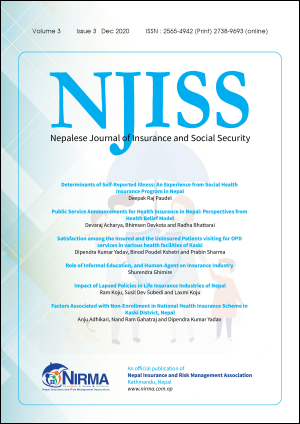
Vol. 3 No. 3 (2020) cover

Vol. 3 No. 3 (2020)

Research Article calendar_today Dec 01, 2020

Determinants of Self-Reported Illness: An Experience from Social Health Insurance Program in Nepal

group

Authors

Deepak Raj Paudel

sell

Keywords

Illness reporting Health insurance Poverty

Abstract

Even though the ultimate goal of social health insurance program is to increase the utilization of health services and reduce the health care expenditure, individuals in developing countries generally do not visit a healthcare provider or spend on healthcare unless they perceive themselves as ill. Thus, the determinants of such illness reporting could have practical significance in a setting, where the social health insurance program was first being implemented in Nepal.

See more

Even though the ultimate goal of social health insurance program is to increase the utilization of health services and reduce the health care expenditure, individuals in developing countries generally do not visit a healthcare provider or spend on healthcare unless they perceive themselves as ill. Thus, the determinants of such illness reporting could have practical significance in a setting, where the social health insurance program was first being implemented in Nepal.

Research Article calendar_today Dec 01, 2020

Public Service Announcements for Health Insurance in Nepal: Perspectives from Health Belief Model

group

Authors

Devraj Acharya, Bhimsen Devkota, Radha Bhattarai

sell

Keywords

Advertisement health information health insurance mass media and communication

Abstract

Public Service Announcement (PSA) is an advertisement to inform the people sponsored by the public company or the governmental agencies. There were several PSAs implemented to inform the people about health insurance (HI). Data from the Health Insurance Board showed low enrolment with high dropout in health insurance programme (HIP). It was found that the PSAs could not attract the people. Therefore, we assessed the PSAs used for the HIP and amomg them, three Radio/FM jingles, eight TV spots, hoarding board, newspapers, and brochure were evaluated using the Health Belief Model (HBM). We found the almost all PSAs have not covered the constructs of HBM. Most of the PSAs have included primarily perceived benefits and perceived susceptibility but missed to include perceived severity, perceived threats, and self-efficacy. Only benefits focused message could not attract the people. Therefore, we recommend that all PSAs need to have all the features of HBM in the PSA messages while notifying and informing the people.

See more

Public Service Announcement (PSA) is an advertisement to inform the people sponsored by the public company or the governmental agencies. There were several PSAs implemented to inform the people about health insurance (HI). Data from the Health Insurance Board showed low enrolment with high dropout in health insurance programme (HIP). It was found that the PSAs could not attract the people. Therefore, we assessed the PSAs used for the HIP and amomg them, three Radio/FM jingles, eight TV spots, hoarding board, newspapers, and brochure were evaluated using the Health Belief Model (HBM). We found the almost all PSAs have not covered the constructs of HBM. Most of the PSAs have included primarily perceived benefits and perceived susceptibility but missed to include perceived severity, perceived threats, and self-efficacy. Only benefits focused message could not attract the people. Therefore, we recommend that all PSAs need to have all the features of HBM in the PSA messages while notifying and informing the people.

Research Article calendar_today Dec 01, 2020

Satisfaction among the Insured and the Uninsured Patients visiting for OPD services in various health facilities of Kaski

group

Authors

Dipendra Kumar Yadav, Binod Poudel Kshetri, Prabin Sharma

sell

Keywords

Health Care Utilization Health Financing Health Insurance OPD Services

Abstract

Health insurance is the process of financial protection against health-related poverty and catastrophic health care cost. Satisfaction of the patients is the perception towards services they get from the health institution. This study aims to assess the satisfaction level and factors associated with it among the insured and the uninsured patients visiting the OPD services in the health facilities of Kaski.

See more

Health insurance is the process of financial protection against health-related poverty and catastrophic health care cost. Satisfaction of the patients is the perception towards services they get from the health institution. This study aims to assess the satisfaction level and factors associated with it among the insured and the uninsured patients visiting the OPD services in the health facilities of Kaski.

Research Article calendar_today Dec 01, 2020

Role of Informal Education, and Human-Agent on Insurance Industry

group

Authors

Shurendra Ghimire

sell

Keywords

Human-Agent Informal Education Insurance Industry Life-skill Learning

Abstract

This article discusses how the insured persons learn to be responsible for managing the risk via insurance and the role of agents in this process. So that, a dozen of purposively selected persons were interviewed with unstructured and open-ended questions. Interpretation of so generated qualitative information suggests that people rarely appreciate insurance, and agents are as dominant as the product in buying decisions. Employing informal education to make citizens responsible for their risk management is almost ineffective. The role of agents in enabling customers as prudent risk managers by raising their awareness about different insurance products is observed as a conflict of interests between the state and the agent. In a liberal society, persuading people by a profit-making company is dominant than the state-delivered awareness program. These findings not only question the role of the insurance agent, a human resource for facilitating people to learn about insurance, as commission-based workers instead of professional but also problematize the legitimacy of transferring the state's responsibility of educating citizens to the private companies.

See more

This article discusses how the insured persons learn to be responsible for managing the risk via insurance and the role of agents in this process. So that, a dozen of purposively selected persons were interviewed with unstructured and open-ended questions. Interpretation of so generated qualitative information suggests that people rarely appreciate insurance, and agents are as dominant as the product in buying decisions. Employing informal education to make citizens responsible for their risk management is almost ineffective. The role of agents in enabling customers as prudent risk managers by raising their awareness about different insurance products is observed as a conflict of interests between the state and the agent. In a liberal society, persuading people by a profit-making company is dominant than the state-delivered awareness program. These findings not only question the role of the insurance agent, a human resource for facilitating people to learn about insurance, as commission-based workers instead of professional but also problematize the legitimacy of transferring the state's responsibility of educating citizens to the private companies.

Research Article calendar_today Dec 01, 2020

Impact of Lapsed Policies in Life Insurance Industries of Nepal

group

Authors

Ram Koju, Susil Dev Subedi, Laxmi Koju

sell

Keywords

Augmented Dickey-Fuller test Generalized Method of Moments Jarqu-Berra test Revival Rate

Abstract

Growth and competition are rapidly rising in life insurance sector. Companies have challenge to stay in the market and earn profit as well as build trust among the end users. In this context, companies have to expand business by selling more life insurance policies. However, only selling new policies might not be the solution to increase profit. Thus, company needs to ensure minimum to zero lapse rates for the sustainable growth of the company. This study investigated the impact of lapse rate and revival rate on net worth, profitability, life fund, and total premium income of life insurance industries in Nepal over the period 2010-2019. The study employed Generalized Method of Moments (GMM) for empirical estimation. The empirical results showed the lapse rate, profitability, revival rate and surrender rate of 23.91%, 2.64%, 88.82% and 3.83%, respectively in the life insurance industries in Nepal during the 10 years’ period. The lapse rate was significantly negatively correlated with life fund and the total premium income with the–model coefficients of 0.1474065 and -0.19244, respectively. Moreover, the empirical estimation showed a significant positive correlation between lapse rate and profitability. This might be because high lapse rate lowers the provision of unexpired risk and life fund resulting in higher amount of profitability. The revival rate was significantly positively correlated with the profitability. This might be because higher revival rate increases the renewal income of a company, resulting in more funds available for investment thereby bringing positive cash inflow for the company. However, the revival rate did not show any significant association with net worth, life fund and total premium income.

See more

Growth and competition are rapidly rising in life insurance sector. Companies have challenge to stay in the market and earn profit as well as build trust among the end users. In this context, companies have to expand business by selling more life insurance policies. However, only selling new policies might not be the solution to increase profit. Thus, company needs to ensure minimum to zero lapse rates for the sustainable growth of the company. This study investigated the impact of lapse rate and revival rate on net worth, profitability, life fund, and total premium income of life insurance industries in Nepal over the period 2010-2019. The study employed Generalized Method of Moments (GMM) for empirical estimation. The empirical results showed the lapse rate, profitability, revival rate and surrender rate of 23.91%, 2.64%, 88.82% and 3.83%, respectively in the life insurance industries in Nepal during the 10 years’ period. The lapse rate was significantly negatively correlated with life fund and the total premium income with the–model coefficients of 0.1474065 and -0.19244, respectively. Moreover, the empirical estimation showed a significant positive correlation between lapse rate and profitability. This might be because high lapse rate lowers the provision of unexpired risk and life fund resulting in higher amount of profitability. The revival rate was significantly positively correlated with the profitability. This might be because higher revival rate increases the renewal income of a company, resulting in more funds available for investment thereby bringing positive cash inflow for the company. However, the revival rate did not show any significant association with net worth, life fund and total premium income.

Research Article calendar_today Dec 01, 2020

Factors Associated with Non-Enrollment in National Health Insurance Scheme in Kaski District, Nepal

group

Authors

Anju Adhikari, Nand Ram Gahatraj, Dipendra Kumar Yadav

sell

Keywords

Factors Kaski Nepal National Health Insurance Scheme

Abstract

Health insurance poses a vital role in developing countries, to attain an equitable health outcome to all citizens by ensuring universal health coverage. This study aims to assess the factors associated with non-enrollment in National Health Insurance Scheme (NHIS) in a setting of Nepal. A cross-sectional study was conducted among 492 households (246 non-enrolled and 246 enrolled) of Kaski district, Nepal from May to August 2020. Data were gathered from face-to-face interview. Data were entered in Epi data 3.1 and analysed by using statistical package for social sciences (SPSS16). Descriptive and inferential statistics were performed to analyze the data. The household without elderly family members were 2.06 times less likely to enroll in the scheme (AOR=2.060, CI=1.141-3.721, p

See more

Health insurance poses a vital role in developing countries, to attain an equitable health outcome to all citizens by ensuring universal health coverage. This study aims to assess the factors associated with non-enrollment in National Health Insurance Scheme (NHIS) in a setting of Nepal. A cross-sectional study was conducted among 492 households (246 non-enrolled and 246 enrolled) of Kaski district, Nepal from May to August 2020. Data were gathered from face-to-face interview. Data were entered in Epi data 3.1 and analysed by using statistical package for social sciences (SPSS16). Descriptive and inferential statistics were performed to analyze the data. The household without elderly family members were 2.06 times less likely to enroll in the scheme (AOR=2.060, CI=1.141-3.721, p

Editorial calendar_today Dec 01, 2020

Editorial Note Vol.3

group

Authors

Fatta Bahadur KC

sell

Keywords

Editorial Note

Abstract

The first issue of Journal of Insurance and Social Security (NJISS) was published in 2018, second issue in 2019 and the third issue is in your hand. The Editorial Board expresses words of gratitude to all authors, reviewers, advisors and readers for their valuable contribution. In coming days too, we expect such invaluable support and encouragement from our valued personalities so that we will be able to publish the journal frequently maintaining standard of the journal with the international repute.

See more

The first issue of Journal of Insurance and Social Security (NJISS) was published in 2018, second issue in 2019 and the third issue is in your hand. The Editorial Board expresses words of gratitude to all authors, reviewers, advisors and readers for their valuable contribution. In coming days too, we expect such invaluable support and encouragement from our valued personalities so that we will be able to publish the journal frequently maintaining standard of the journal with the international repute.