Journal Volume

Vol. 4 No. 1 (2021)

Explore the published articles and volume details.

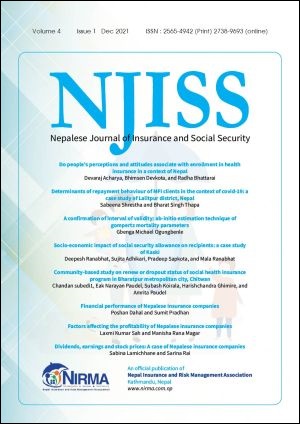
Vol. 4 No. 1 (2021) cover

Vol. 4 No. 1 (2021)

Research Article calendar_today Apr 02, 2026

Public Service Announcements for Health Insurance in Nepal: Perspectives from Health Belief Model

group

Authors

Devraj Acharya, Bhimsen Devkota

sell

Keywords

Advertisement health information health insurance mass media and communication

Abstract

Public Service Announcement (PSA) is an advertisement to inform the people sponsored by the public company or the governmental agencies. There were several PSAs implemented to inform the people about health insurance (HI). Data from the Health Insurance Board showed low enrolment with high dropout in health insurance programme (HIP). It was found that the PSAs could not attract the people. Therefore, we assessed the PSAs used for the HIP and amomg them, three Radio/FM jingles, eight TV spots, hoarding board, newspapers, and brochure were evaluated using the Health Belief Model (HBM). We found the almost all PSAs have not covered the constructs of HBM. Most of the PSAs have included primarily perceived benefits and perceived susceptibility but missed to include perceived severity, perceived threats, and self-efficacy. Only benefits focused message could not attract the people. Therefore, we recommend that all PSAs need to have all the features of HBM in the PSA messages while notifying and informing the people.

See more

Public Service Announcement (PSA) is an advertisement to inform the people sponsored by the public company or the governmental agencies. There were several PSAs implemented to inform the people about health insurance (HI). Data from the Health Insurance Board showed low enrolment with high dropout in health insurance programme (HIP). It was found that the PSAs could not attract the people. Therefore, we assessed the PSAs used for the HIP and amomg them, three Radio/FM jingles, eight TV spots, hoarding board, newspapers, and brochure were evaluated using the Health Belief Model (HBM). We found the almost all PSAs have not covered the constructs of HBM. Most of the PSAs have included primarily perceived benefits and perceived susceptibility but missed to include perceived severity, perceived threats, and self-efficacy. Only benefits focused message could not attract the people. Therefore, we recommend that all PSAs need to have all the features of HBM in the PSA messages while notifying and informing the people.

Research Article calendar_today Dec 31, 2021

Do people's perceptions and attitudes associate with enrollment in health insurance in a context of Nepal?

group

Authors

Devraj Acharya, Bhimsen Devkota, Radha Bhattarai

sell

Keywords

Attitude Enrollment Health Insurance Perception

Abstract

The Government of Nepal introduced the health insurance [HI] program in three districts, in 2016 and now has been expanded almost all districts. Since it was a new initiative, there was no clear evidence on people's attitude, perception, and awareness, which continues until now. This study, therefore, intended to assess the perception and attitude of household heads towards enrollment in HI.

See more

The Government of Nepal introduced the health insurance [HI] program in three districts, in 2016 and now has been expanded almost all districts. Since it was a new initiative, there was no clear evidence on people's attitude, perception, and awareness, which continues until now. This study, therefore, intended to assess the perception and attitude of household heads towards enrollment in HI.

Research Article calendar_today Dec 31, 2021

Determinants of repayment behaviour of MFI clients in the context of COVID-19: a case study of Lalitpur District, Nepal

group

Authors

Sabeena Shrestha, Bharat Singh Thapa

sell

Keywords

Microfinance MFIs Covid 19 and Nepal Loan repayment

Abstract

This paper investigated factors affecting repayment performance of MFI clients in the context of COVID-19. Business characteristics, borrowers’ characteristics and lenders’ behavior were identified and predictors of loan repayment. A telephone interview using a full-fledged questionnaire was conducted among randomly chosen 160 loan clients of various microfinance institutions in Mahalaxmi municipality of Lalitpur district during Covid 19 pandemic (June-July, 2020). The descriptive statistics, correlation analysis, binary logistic regression analysis analyzed the data and qualitative analysis is done to support the result of research. The finding of study reveals that age of the borrower, educational level of borrowers, types of the business and profit generated business influence the repayment of loan. However, family size, skills, age of business, work performance, transparent communication and clarity of MFI policy does not have any impact on repayment of loan. COVID-19 pandemic has affected all types of business and created poor cash flow in the market and due to lockdown, the source of income has been decreased which causes large number of delay repayment of monthly installment is decrease in profit due to decrease in revenue of the business.

See more

This paper investigated factors affecting repayment performance of MFI clients in the context of COVID-19. Business characteristics, borrowers’ characteristics and lenders’ behavior were identified and predictors of loan repayment. A telephone interview using a full-fledged questionnaire was conducted among randomly chosen 160 loan clients of various microfinance institutions in Mahalaxmi municipality of Lalitpur district during Covid 19 pandemic (June-July, 2020). The descriptive statistics, correlation analysis, binary logistic regression analysis analyzed the data and qualitative analysis is done to support the result of research. The finding of study reveals that age of the borrower, educational level of borrowers, types of the business and profit generated business influence the repayment of loan. However, family size, skills, age of business, work performance, transparent communication and clarity of MFI policy does not have any impact on repayment of loan. COVID-19 pandemic has affected all types of business and created poor cash flow in the market and due to lockdown, the source of income has been decreased which causes large number of delay repayment of monthly installment is decrease in profit due to decrease in revenue of the business.

Research Article calendar_today Dec 31, 2021

A confirmation of the expected interval: Ab initio estimation technique of parsimonious Gompertz mortality parameters

group

Authors

Gbenga Michael Ogungbenle

sell

Keywords

Gompertz Intencity Mortality Interval of Validity

Abstract

The Gompertz law states a functional relationship on exponential scale between instantaneous intensity and age. The objective is to first estimate the model parameters by using mortality data and then confirm the interval of validity for the estimated parameters. The parsimonious model is implicitly expressed in terms of age and level of mortality while the force of mortality is the dependent variable. Current contributions in actuarial literature have made it tractable to obtain life span from the actuarial point of view, making the life table invaluable analytical tool for insurers. Mortality functions which have been developed recently possess sophisticated actuarial techniques with many parameters hence they are very complex to estimate numerically making it difficult to fit to mortality data. In order to overcome this problem, we need to employ numerical algebraic method to estimate the appropriate values of model parameters and which may enable us fit the function to mortality data. In this paper, the direct algebraic method offers simpler perspective of approximating mortality parameter and was decomposed into systems of algebraic equations. We observed that mortality over all ages for males is lower than that of females while the initial mortality for male is higher than that of female. The R-language software was employed in the computation. In view of actuarial benchmarks, our results confirm that the values of and for both males and females lie within the expected interval. (see PDF for further information).

See more

The Gompertz law states a functional relationship on exponential scale between instantaneous intensity and age. The objective is to first estimate the model parameters by using mortality data and then confirm the interval of validity for the estimated parameters. The parsimonious model is implicitly expressed in terms of age and level of mortality while the force of mortality is the dependent variable. Current contributions in actuarial literature have made it tractable to obtain life span from the actuarial point of view, making the life table invaluable analytical tool for insurers. Mortality functions which have been developed recently possess sophisticated actuarial techniques with many parameters hence they are very complex to estimate numerically making it difficult to fit to mortality data. In order to overcome this problem, we need to employ numerical algebraic method to estimate the appropriate values of model parameters and which may enable us fit the function to mortality data. In this paper, the direct algebraic method offers simpler perspective of approximating mortality parameter and was decomposed into systems of algebraic equations. We observed that mortality over all ages for males is lower than that of females while the initial mortality for male is higher than that of female. The R-language software was employed in the computation. In view of actuarial benchmarks, our results confirm that the values of and for both males and females lie within the expected interval. (see PDF for further information).

Research Article calendar_today Dec 31, 2021

Socio-economic status of the recipients of social security allowance: a case study of Kaski, Nepal

group

Authors

Deepesh Ranabhat, Sujita Adhikari, Pradeep Sapkota, Mala Ranabhat

sell

Keywords

Social Security Allowance Old Age Allowance Socio-Economic Impact Nepal

Abstract

The research aims to assess the impact of social security allowance on socio-economic status of the recipients and differences in socio-economic status of the recipients. Multistage sampling technique has been used for the selection of samples. The data has been collected through self-structured questionnaires from 170 respondents who have been receiving social security allowance provided by the Government of Nepal. Thus, descriptive as well as cross-sectional research design has been used for this study. The study found that social security benefits play very important role in improving socio-economic status of the beneficiaries by enhancing the economic well-being, health access, social status, self-respect and respect from others, and living standard of the recipients. The study also found that there is a significant difference in socio-economic well-being of recipients by area of residence, employment status, duration of getting allowance, and allowance as major source of income.

See more

The research aims to assess the impact of social security allowance on socio-economic status of the recipients and differences in socio-economic status of the recipients. Multistage sampling technique has been used for the selection of samples. The data has been collected through self-structured questionnaires from 170 respondents who have been receiving social security allowance provided by the Government of Nepal. Thus, descriptive as well as cross-sectional research design has been used for this study. The study found that social security benefits play very important role in improving socio-economic status of the beneficiaries by enhancing the economic well-being, health access, social status, self-respect and respect from others, and living standard of the recipients. The study also found that there is a significant difference in socio-economic well-being of recipients by area of residence, employment status, duration of getting allowance, and allowance as major source of income.

Research Article calendar_today Dec 31, 2021

Dividends, earnings and stock prices: a case of Nepalese insurance companies

group

Authors

Sabina Lamichhane, Sarina Rai

sell

Keywords

Dividend Per Share Earnings Per Share Dividend Payout Ratio Price Earnings Ratio

Abstract

The study examines the relationship among dividends, earnings and stock prices of Nepalese insurance companies. Market price per share and stock return are the dependent variables. The independent variables are earning per share, dividend per share, dividend payout ratio, PE ratio, return on assets and return on equity. This study is based on secondary data of 15 insurance companies with 105 observations for the period of 2011/12 to 2017/18. The data were collected from the annual reports of the selected insurance companies. The regression models are estimated to test the significance and importance of dividends, earnings and stock prices in Nepalese insurance companies.

See more

The study examines the relationship among dividends, earnings and stock prices of Nepalese insurance companies. Market price per share and stock return are the dependent variables. The independent variables are earning per share, dividend per share, dividend payout ratio, PE ratio, return on assets and return on equity. This study is based on secondary data of 15 insurance companies with 105 observations for the period of 2011/12 to 2017/18. The data were collected from the annual reports of the selected insurance companies. The regression models are estimated to test the significance and importance of dividends, earnings and stock prices in Nepalese insurance companies.

Research Article calendar_today Dec 31, 2021

Community-based study on renew or dropout status of social health insurance program in Bharatpur Metropolitan City, Chitwan

group

Authors

Chandan Subedi, Eak Narayan Paudel, Subash Koirala, Harishchandra Ghimire, Amrita Paudel

sell

Keywords

Community Based Drop out renew social health insurance

Abstract

Health insurance is emerging as the most preferred form of the health financing mechanism. Higher dropout puts a threat to governments target (Social health security program) of 100% enrolment by 2030.This study aimed at accessing the factors associated with current SHI status (renew or dropout) in Bharatpur metropolitan city.

See more

Health insurance is emerging as the most preferred form of the health financing mechanism. Higher dropout puts a threat to governments target (Social health security program) of 100% enrolment by 2030.This study aimed at accessing the factors associated with current SHI status (renew or dropout) in Bharatpur metropolitan city.

Research Article calendar_today Dec 31, 2021

Factors affecting the profitability of Nepalese insurance companies

group

Authors

Laxmi Kumar Sah, Manisha Rana Magar

sell

Keywords

Return on Assets Return on Equity Liquidity Tangibility

Abstract

This study examines the factors affecting profitability in the context of Nepalese insurance companies. Return on assets and return on equity are selected as the dependent variables. The selected independent variables are liquidity, tangibility, premium growth, firm age and firm size. The study is based on secondary data of 21 insurance companies with 168 observations for the period from 2011/12 to 2018/19. The data is collected from the reports published by Beema Samiti and Annual Reports of selected insurance companies. The regression models are estimated to test the factor affecting the profitability of Nepalese insurance companies.

See more

This study examines the factors affecting profitability in the context of Nepalese insurance companies. Return on assets and return on equity are selected as the dependent variables. The selected independent variables are liquidity, tangibility, premium growth, firm age and firm size. The study is based on secondary data of 21 insurance companies with 168 observations for the period from 2011/12 to 2018/19. The data is collected from the reports published by Beema Samiti and Annual Reports of selected insurance companies. The regression models are estimated to test the factor affecting the profitability of Nepalese insurance companies.

Research Article calendar_today Dec 31, 2021

Financial performance of Nepalese insurance companies

group

Authors

Sumit Pradhan, Poshan Dahal

sell

Keywords

Liquidity Management Firm Performance Return on Assets Earnings per Share

Abstract

This study examines the financial performance of Nepalese insurance companies. The dependent variables are return on assets and earnings per share while independent variables include insurance premium, firm size, current ratio and solvency ratio. Twenty-one insurance companies among them 8 are life insurance and 13 are non-life insurance companies with 105 observations for the period of 2070/71 to 2074/75, were selected for this study. The data were collected from insurance and financial statistics published by Beema Samiti and annual reports of the selected Nepalese insurance companies. The correlation coefficient and regression models were estimated to test the significance and importance of liquidity management on financial performance of Nepalese insurance companies.

See more

This study examines the financial performance of Nepalese insurance companies. The dependent variables are return on assets and earnings per share while independent variables include insurance premium, firm size, current ratio and solvency ratio. Twenty-one insurance companies among them 8 are life insurance and 13 are non-life insurance companies with 105 observations for the period of 2070/71 to 2074/75, were selected for this study. The data were collected from insurance and financial statistics published by Beema Samiti and annual reports of the selected Nepalese insurance companies. The correlation coefficient and regression models were estimated to test the significance and importance of liquidity management on financial performance of Nepalese insurance companies.